
Most people assume fast typists are just "naturally quick." They aren't. Typing speed is a trainable skill, and four weeks of the right practice will take you further than months of random typing. If you're preparing for GCC-TBC's 30 or 40 WPM, here's a plan that actually works — no shortcuts, no gimmicks.
Accuracy first, speed second
The GCC-TBC exam scores your net speed — every mistake pulls the number down. A messy 45 WPM can score lower than a clean 35 WPM. So the goal isn't "type faster," it's "type cleanly, then let speed follow." Slow down until you're consistently above ~95% accuracy, then push the pace. Speed built on sloppy habits always falls apart under exam pressure.
Fix your technique — it's the real ceiling
- Touch typing: all ten fingers, hands resting on the home row (ASDF – JKL;), eyes on the screen, not the keyboard.
- If you "hunt and peck," un-learning it in week one is worth the short-term slowdown — it's the single biggest limit on how fast you can ever get.
- For Marathi or Hindi, learn your keyboard layout properly from day one, in the exact language you'll be examined in.
The 4-week plan
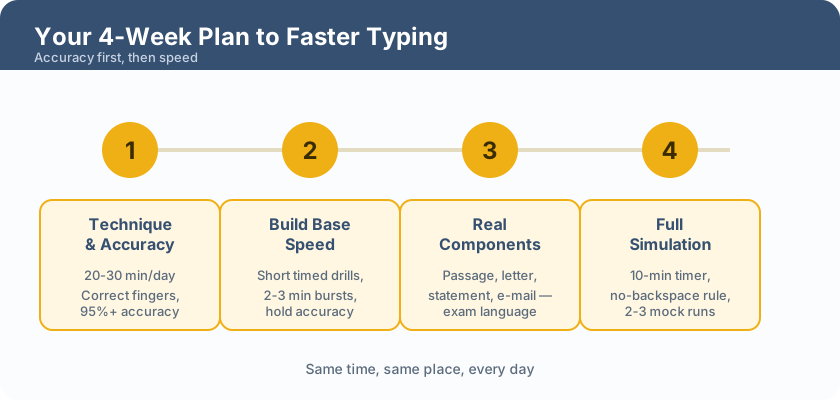
Week 1 — Technique & accuracy. 20–30 min a day. Slow, deliberate typing with the correct fingers. Target 95%+ accuracy and ignore speed for now.
Week 2 — Build base speed. Short timed drills of 2–3 minutes. Nudge the pace up while holding your accuracy. This is where you'll see the most obvious gains.
Week 3 — Practise the real components. Now type the actual exam pieces — the speed passage, business letter, statement/table and e-mail — in your exam language. Learn the format of each so nothing surprises you.
Week 4 — Full simulation. Practise under the real 10-minute timer and the no-backspace rule. Do two or three complete mock runs so exam day feels like just another practice session.
Breaking through a plateau
Almost everyone hits a wall (often around 25–30 WPM). To get past it: slow down for a day to reset your accuracy; drill your weakest letters and combinations; start typing common words as whole "chunks" instead of letter-by-letter; and rest — tired hands get slower and sloppier.
How much should you practise?
Consistency beats marathons. Thirty focused minutes every day for four weeks will beat one three-hour session a week — same total time, far better result. Same time, same place, every day.
Practise on the real exam pattern
Online typing games build raw speed, but they don't have the letter, the statement, or the board's marking — so a high score there doesn't tell you whether you'll pass. Practising on the actual GCC-TBC pattern, with the real timer and board-accurate marking, means your practice score genuinely predicts your exam score. (This is exactly what GCC-TBC Mentor is built for — same layout, timer, no-backspace rule and marking — and there's a free browser demo if you'd like to try it before anything else.)
Frequently asked questions
How long does it take to reach 30 WPM?
With correct technique and daily practice, most beginners reach a steady 30 WPM in about 4–8 weeks. 40 WPM takes longer — be patient and keep accuracy high.
Is 30 minutes a day really enough?
Yes, if it's daily and focused. Consistency matters more than the length of any single session.
Does my exam language change the method?
The method is identical; only the keyboard layout differs. Always practise in the exact language you'll be tested in.
Should I avoid backspace while practising?
Train yourself to type cleanly without leaning on it. The exam doesn't let you freely fix mistakes, so practising that way builds the right habit early.
Note: Exam figures (speeds, timing, marks) follow recent MSCE notifications and can be revised — always confirm the current official notification at mscepune.in before you apply.
---