
Ask most GCC-TBC candidates how their preparation is going and they'll tell you their typing speed. Ask about the theory and you often get a blank look. That's the trap: the objective section is only 30 marks, but you have to pass it separately — and every year, people with good typing speed lose the certificate because they ignored it.
You must pass theory on its own
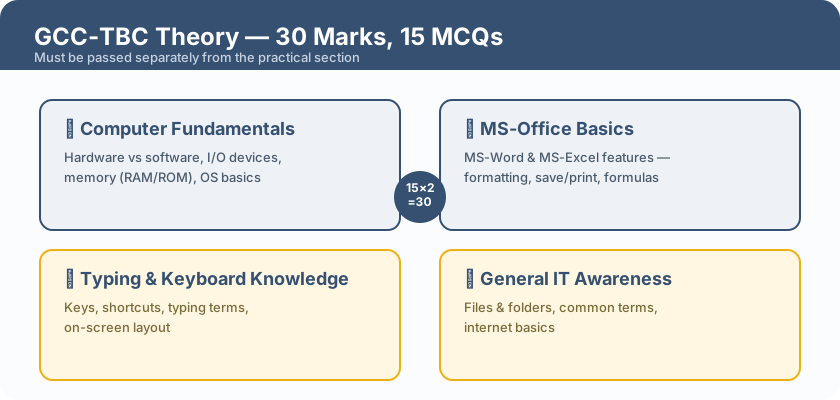
GCC-TBC is out of 100 — 70 practical + 30 theory — and the rule is at least 40% in each section. That means you need 12 out of 30 in theory, no matter how well you type. A brilliant typing score cannot rescue a failed theory paper. Treat the 30-mark objective as a section you have to clear, not an afterthought.
What the theory section covers
The objective paper is 15 multiple-choice questions × 2 marks, drawn from the computer- and typing-theory syllabus. In practice, questions cluster around a few areas:
- Computer fundamentals — hardware vs software, input/output devices, memory (RAM/ROM), the operating system's basic jobs.
- MS-Office basics — what MS-Word and MS-Excel do; common features (formatting, save/print, simple formulas).
- Typing & keyboard knowledge — keys, shortcuts, typing terms, the on-screen layout.
- Basic IT / general computer awareness — files and folders, common terms, internet basics.
These are all "learn-it-once" facts. None of it is hard — but you do have to revise it, because you can't reason your way to "which key does X" if you've never read it.
How to prepare (the efficient way)
- Read short notes, not fat books. You need exam-relevant facts, not a computer-science degree. Concise topic notes are enough.
- Practise MCQs — a lot of them. Theory sticks when you test yourself, not when you re-read. Working through a large question bank trains you to recognise how the same fact is asked in different ways.
- Revise your weak topics. Every practice set shows you what you keep getting wrong. Go back to those specific topics instead of re-reading everything.
- Practise in your exam language. If you'll be examined in Marathi, revise the terms in Marathi so the wording on exam day feels familiar.
MCQ strategy for exam day
- Answer the easy ones first, then return to the rest — don't let one hard question eat your time.
- Eliminate wrong options. Even when you're unsure, ruling out two obviously-wrong choices doubles your odds.
- Don't overthink. GCC-TBC theory tests recall, not trick logic. Your first instinct on a fact you've revised is usually right.
Where a good practice tool helps
The fastest way to get theory-ready is a large, exam-style question bank you can drill again and again — with instant answers so you learn as you go. GCC-TBC Mentor ships a 600+ MCQ theory question bank in Marathi, English and Hindi alongside the typing practice, so you prepare both sections in one place (there's a free demo to try it).
Frequently asked questions
How many questions are in the GCC-TBC theory section?
15 multiple-choice questions of 2 marks each — 30 marks total.
How many marks do I need to pass theory?
At least 40% of the section — that's 12 out of 30 — and it's judged separately from the practical.
Is there negative marking?
GCC-TBC objective questions are not typically negatively marked, so it's worth attempting every question — but always confirm the current official notification.
What topics should I study?
Computer fundamentals, basic MS-Office (Word/Excel), typing and keyboard knowledge, and general computer awareness.
Can I prepare for the theory in Marathi?
Yes — revise and practise the MCQs in the same language you'll sit the exam in.
Note: Section marks and rules follow recent MSCE notifications and can be revised — always confirm the current official notification at mscepune.in before you apply.
---