
The business letter and the statement are two of the four practical components in GCC-TBC, worth 15 marks each — but they test genuinely different skills. Confusing their formats, or practising one far more than the other, is one of the more avoidable ways candidates lose marks. Here's exactly how they differ.
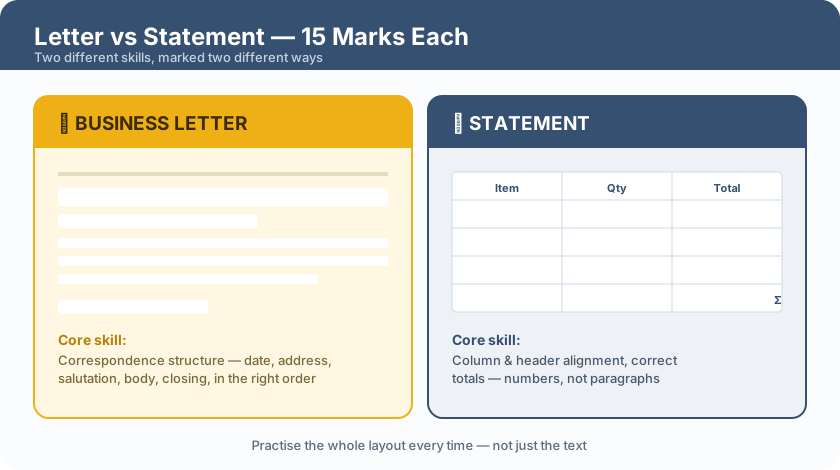
The letter — correspondence formatting
A GCC-TBC business letter tests whether you can lay out formal correspondence correctly, not just type text quickly.
What it actually involves:
- A defined structure — sender/date block, recipient address, subject line, salutation, body paragraphs, closing and signature block, typed in the right order and position.
- Spacing and alignment that follow standard business-letter convention, not free-form formatting.
- Getting the content right (typing the given text accurately) and the layout right — both are marked.
Where marks are commonly lost: misplaced blocks (date in the wrong position, salutation formatted incorrectly), inconsistent spacing between sections, and — same as every component — plain typing errors in the body text.
The statement — tabulation, not prose
A GCC-TBC statement is a completely different skill: typing data into a table, with correct column alignment, headings and totals — not paragraphs of text.
What it actually involves:
- Setting up columns and rows to match the given data exactly — headers in the right place, values aligned under the correct column.
- Numeric alignment — figures typically align consistently (commonly right-aligned) so columns of numbers read cleanly, and totals/subtotals are positioned and calculated correctly where required.
- Precision matters more than in prose: a number in the wrong column is a clear, countable error in a way a slightly-off sentence isn't.
Where marks are commonly lost: columns that drift out of alignment as the table fills in, headers that don't match the given format, and arithmetic mistakes in totals.
Side by side
| Business Letter | Statement | |
|---|---|---|
| Marks | 15 | 15 |
| Core skill | Correspondence formatting | Tabular/column alignment |
| Structure | Paragraphs, blocks (address, salutation, body, closing) | Rows and columns, headers, totals |
| Common error | Misplaced blocks, spacing | Column drift, header mismatch, totals |
| Practice focus | Layout memorisation + accurate typing | Column discipline + numeric accuracy |
How to practise each one properly
For the letter: don't just type the body text — practise the whole structure every time, including the date block, address and closing, until the layout is automatic. A letter typed with perfect content but a wrong structure still loses marks.
For the statement: practise with real tabular data, not text. Get comfortable moving between columns cleanly (tab-based navigation, not manual spacing), and double-check totals before you consider a statement "done" — arithmetic slips are an easy, avoidable loss.
For both: type them in your exam language (Marathi, English or Hindi) specifically — format conventions and common vocabulary differ slightly by language, so practising the format in a different language than your exam doesn't fully transfer.
Why practising on the real format matters here more than anywhere else
Unlike the speed passage — which is just continuous text — the letter and statement are format-graded: the layout itself carries marks, separate from typing accuracy. A generic typing test has no concept of "wrong block position" or "column out of alignment," so it simply cannot tell you whether your formatting would pass. Practising on the actual GCC-TBC letter and statement templates, with marking that checks structure the way the board does, is the only way to know your formatting is actually exam-ready.
Frequently asked questions
Are the letter and statement marked the same way?
No — the letter is marked on correspondence structure and content accuracy; the statement is marked on tabular layout, column alignment and (where applicable) correct totals.
Which one is harder — letter or statement?
It depends on the person. Some find the letter's structure easier to memorise; others find the statement's column discipline more natural. Both are worth equal marks (15 each), so don't neglect either.
Do I need to memorise the exact letter format?
Yes — the structure (date, address, salutation, body, closing) is fixed convention, and getting it consistently right is what the layout marks are for.
How do I avoid column drift in the statement?
Use tab-based navigation between columns rather than manual spacing, and periodically check that your columns still align as you fill in more rows.
Note: Exact format conventions and marking details follow recent MSCE notifications and can be revised — always confirm the current official notification at mscepune.in before your exam.
---